Skip to content
AI servicesAI agents & automation

AI agents that do the repetitive work

I design and build dependable agents that read, decide, draft, route, and update the tools your team already uses—without handing the keys to a mystery black box.
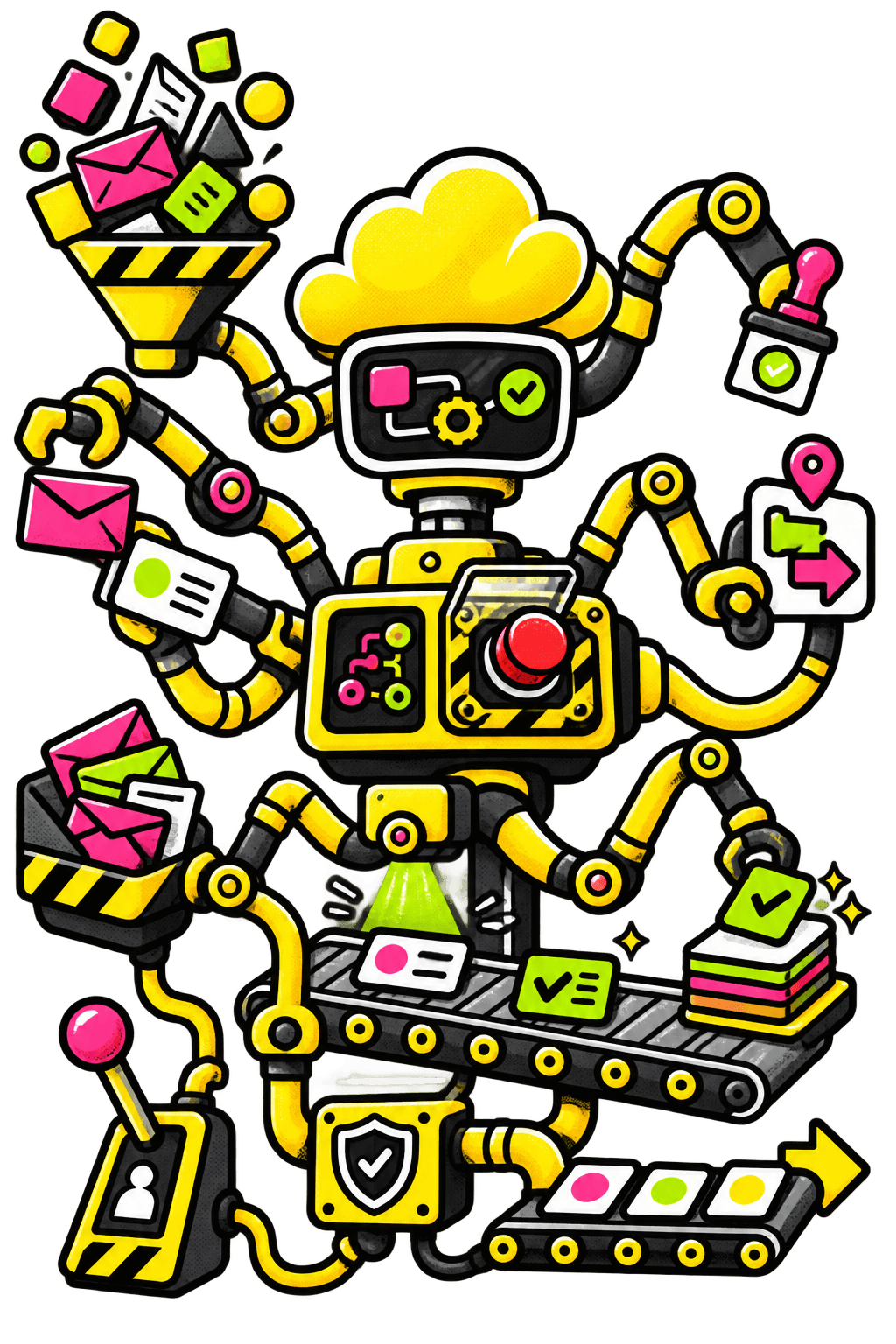
A playful multi-armed automation machine sorting messages, approvals, and business tasks

The offer

Start with one costly workflow. Get a working pilot, clear guardrails, and a measurable before-and-after.

Working pilot in days

What changes

Useful outcomes. Not AI theatre.

01

Fewer manual steps

Remove repetitive triage, data entry, follow-up, and reporting from the team’s queue.

02

Faster response times

Classify and route work as it arrives, while escalating edge cases to a person.

03

Controlled automation

Add permissions, human approvals, logs, fallbacks, and spend limits from day one.

Good fit

Built for a real constraint

  • Teams copying information between systems
  • High-volume inbox, document, or support work
  • Processes held together by spreadsheets and reminders
  • Businesses that need approvals and audit trails

What you get

A build you can inspect

  • Workflow and opportunity map
  • Agent prototype using your real process
  • Connections to the tools and APIs you already use
  • Human approval and exception paths
  • Evaluation set, logs, and operating notes
  • Production rollout plan with costs and risks

Delivery model

Small bet. Fast proof. Then scale.

  1. 1

    Find the bottleneck

    We choose one frequent, painful workflow with a visible cost and a clear owner.

  2. 2

    Build the safe path

    I map decisions, permissions, failure modes, and where a human must stay involved.

  3. 3

    Pilot with real work

    You test an end-to-end slice against real examples before we expand the scope.

  4. 4

    Measure and roll out

    We compare time, quality, and cost against the old process, then harden what works.

FAQ

Straight answers

What can an AI agent actually do?
A useful agent can combine language-model reasoning with defined tools: reading documents, looking up records, drafting responses, updating a CRM, creating tickets, or asking for approval. The best first use case is narrow, frequent, and measurable.
Will it run without human oversight?
Only where that is safe and useful. High-impact actions can require approval, while low-risk steps can run automatically. Permissions, limits, logs, and fallbacks are part of the design—not an afterthought.
Can it work with our existing software?
Usually, yes. I work with the APIs, webhooks, databases, and automation features your tools expose. Discovery confirms what can be integrated cleanly before a build is scoped.
How do we know it is worth doing?
We agree a baseline such as minutes per case, response time, rework, or cost per task. The pilot is judged against that baseline so the next decision is based on evidence.

No-obligation project call

Bring me the bottleneck

Tell me what is slow, expensive, or hard to scale. I'll reply within 24 hours with useful questions and the clearest next step—even if that step is not AI.

What happens next

A short fit check, a focused call, then a written scope covering outcome, timeline, cost, risks, and what I need from you.

Or email hello@webdevherts.co.uk
Ready